Panama company and director search
Search the companies and directors registered in the Registro Público de Panamá, and read how the register works: what it records, what is public and what the law keeps private.
1,149,929 companies and 1,246,095 directors of Panama, from the records of the Registro Público de Panamá. Newest filing received: 12 November 2026.
Searching by name is free. Documents are paid one at a time; no subscription is necessary.
Panama company documents
Search the company, or open a document below and choose the company there. Each document page says what it contains and gives the price and the delivery time before you pay, with pages of a real example where we have one.
- Certified Panama Report
Certified Panama company report: status, directors and deeds.
Electronic PDF by e-mail, within 1 business day€99View details - Panama Historical Company Certificate
Official historical certificate of a Panama company from the Public Registry.
Electronic PDF by e-mail, within 1 business day€150View details
Dato Capital is a private company, not the Registro Público de Panamá. A certificate or a copy is a document of the register that we obtain for you; a report is compiled by Dato Capital from the register's records.
Panama company information at a glance
Every company has its own folio in the Registro Público de Panamá (Public Registry of Panama), and the folio number is its register number (company numbers).1114 The register is public and anyone can consult it freely, article 1755 of the Código Civil (Civil Code).1
- Public: the name, type, date of registration and status; the articles (objects, capital, office, duration); the directors, officers and resident agent; the subscribers of a sociedad anónima; the members of a limited liability company; the council of a foundation (what is public).1346
- Not public: the later shareholders of a sociedad anónima, the beneficial owners, the beneficiaries of a foundation (unless the charter names them) and the accounting records. Ordinary private companies are not required to file annual accounts at the Registro Público; banks publish audited statements under their own law, and a foreign corporation files its last balance sheet once, to register (shareholders, beneficial owners, financial statements).3691123
- Changes: each change, such as new directors or an amendment of the articles, is registered on the folio from a public deed, a final court decision or another authentic document expressly specified by law for the purpose (filings).13
- Documents: the Registro Público issues certificates on the companies it registers, and notaries issue authenticated copies of deeds; both can be apostilled for use in the other states of the Hague Apostille Convention. A company in arrears with its annual fee gets no certificates, except for an authority or a third party who needs one to enforce its rights (documents and certificates).1921
- Status: the Registro Público suspends a company that has had no resident agent for more than 90 days or has not paid its annual fee for three consecutive years, and since 2019 the folio shows the status "suspendido". In February and March 2026 it dissolved 206,112 legal persons that had been marked for dissolution in 2016 for unpaid annual fees (company status).10141928
The Registro Público de Panamá
Companies in Panama are registered in the Registro Mercantil (Mercantile Register), one of the four sections of the Registro Público with property, mortgages and persons, article 1754 of the Código Civil, as amended by Ley 43 de 1925 (Law 43 of 1925).1 Private-interest foundations have a section of their own, article 33 of Ley 25 de 1995 (Law 25 of 1995).6
Only titles in a public deed (escritura pública), a final court decision or order, or another authentic document expressly specified by law for the purpose can be registered, article 1756.1 A document that must be registered does not affect third parties until it is presented to the register, article 1761.1 The registrar checks the legality of each document, article 1795.1
The search on this page covers 1,149,929 companies from the register of Panama. The newest filing held is dated 12 November 2026.
History
The rules of the register are in the Código Civil of 1916, in force since 1 July 1917.1 The Registro Público is an autonomous state entity with its own legal personality and budget, created by Ley 3 de 1999 (Law 3 of 1999), article 1.2 Before that law it was a department of the Ministerio de Gobierno y Justicia (Ministry of Government and Justice), article 20.2
Types of company
Sociedad anónima (S.A.)
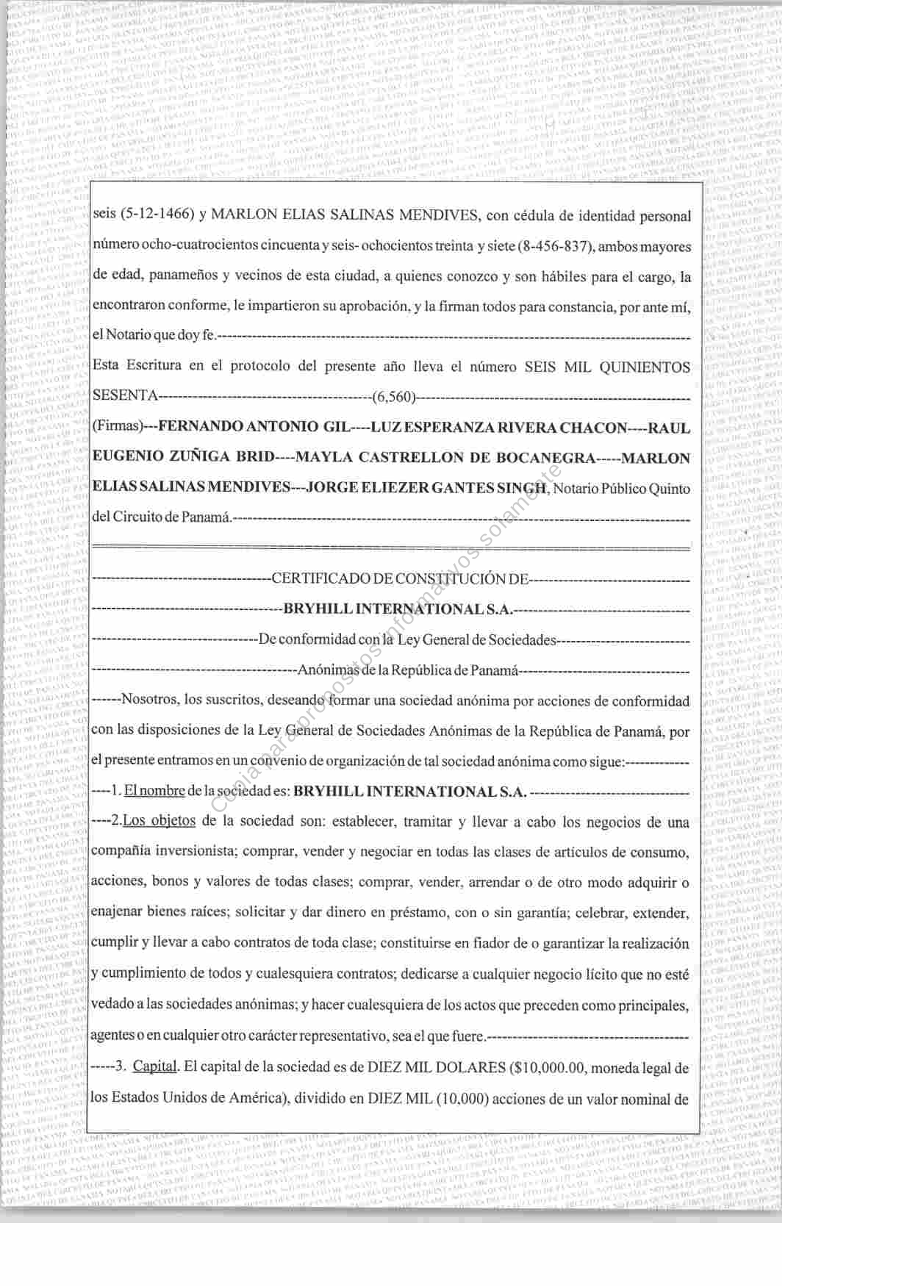
The sociedad anónima (corporation) is governed by Ley 32 de 1927 (Law 32 of 1927), in force since 1 April 1927.3 Two or more adults of any nationality, resident in Panama or not, can form one for any lawful purpose, article 1. The qualification manual of the Registro Público also accepts legal persons as subscribers of the pacto social, with their registration details and the person who represents them.22 The name must show that it is a sociedad anónima and can be in any language, article 2. The law sets no minimum capital: the pacto social (articles of incorporation) states the capital and the number and value of the shares, article 2. A shareholder is liable to creditors only for the amount unpaid on his shares, article 39.3
Sociedad de responsabilidad limitada (S. de R.L.)
The limited liability company is governed by Ley 4 de 2009 (Law 4 of 2009).4 Two or more natural or legal persons can form one, article 4. The name ends in "Sociedad de Responsabilidad Limitada" or "S. de R.L.", article 1. Each member is liable up to the contribution made or promised, article 25. Ley 4 de 2009 repealed Ley 24 de 1966 (Law 24 of 1966), article 52.4 The 1966 law had allowed two to twenty members and a capital of PAB 2,000 to PAB 500,000, articles 4 and 5.5
Fundación de interés privado
The private-interest foundation is governed by Ley 25 de 1995.6 One or more natural or legal persons can create one, article 1. It cannot pursue profit, but it may carry out commercial acts that are not habitual, article 3. The name includes the word "fundación" and the initial assets are at least PAB 10,000, article 5. The foundation has legal personality once its acta fundacional (foundation charter) is registered, article 9.6
Sociedad de emprendimiento
The sociedad de emprendimiento (entrepreneurship company) was created for micro and small businesses by Ley 186 de 2020 (Law 186 of 2020), in force one year after its promulgation, articles 1, 3 and 50.7 Since Ley 451 de 2024 (Law 451 of 2024) came into force, six months after 31 October 2024, it is formed by two to ten adults who are permanent residents of Panama, article 5 as amended.8 The minimum capital is PAB 500 and the members' liability is limited to their contribution, articles 6 and 13. A resident agent is optional, article 7.7
Foreign companies
A foreign corporation may have offices and do business in Panama after it presents its documents to the Registro Mercantil for registration, article 90 of Ley 32 de 1927. The documents required include the protocolised articles; a copy of its last balance sheet, with a statement of the part of its capital used or to be used for business in Panama; and a certificate that it is constituted and authorised under the laws of its country.3
Company numbers
Each legal person has its own folio mercantil (mercantile folio) in the Registro Público, on which its status is noted, article 3 of Decreto Ejecutivo 905 de 2019 (Executive Decree 905 of 2019).14 The folio number is the company's register number: the beneficial-owner law identifies each legal person by its name, folio number and date of registration, article 10 of Ley 129 de 2020 (Law 129 of 2020).11
The tax number is the Registro Único de Contribuyente (Single Taxpayer Register) of the Dirección General de Ingresos (Directorate General of Revenue). The resident agent's yearly return lists each company with its name and this number, article 3 of Ley 52 de 2016 (Law 52 of 2016).9 For a sociedad de emprendimiento the tax number is created automatically from the folio, article 11 of Ley 186 de 2020.7
What is public
The table describes the information normally obtainable from the Registro Público. The legal basis gives the law and its year; the year of a law does not show when an item first became public.
Scroll sideways to see all columns.
| Item | Public | Legal basis |
|---|---|---|
| Name, type, date of registration | Yes | Código Civil (1916) arts 1753, 17551 |
| Articles: objects, capital, office, duration | Yes | Ley 32 de 1927 arts 2, 63 |
| Directors, officers, resident agent | Yes | Ley 32 de 1927 arts 2, 633 |
| Powers of attorney | Yes | Código Civil (1916) art. 17531 |
| Subscribers of a sociedad anónima | Yes | Ley 32 de 1927 art. 23 |
| Later shareholders of a sociedad anónima | Not listed in the public register (kept by the company) | Ley 32 de 1927 art. 363 |
| Members of a limited liability company | Yes | Ley 4 de 2009 arts 5, 11, 264; before 2009 Ley 24 de 1966 art. 145 |
| Foundation council | Yes | Ley 25 de 1995 art. 56 |
| Foundation beneficiaries | Not required in the register: the charter must state only how they are designated | Ley 25 de 1995 art. 56 |
| Beneficial owners | No public access; access for the competent authorities | Ley 129 de 2020 arts 8, 1411 |
| Annual accounts | Not filed for ordinary private companies; banks have their own rules; a foreign corporation files its last balance sheet once, to register (financial statements) | Ley 32 de 1927 art. 903; Ley Bancaria arts 87–8823 |
| Accounting records | No (kept by the company where its management decides; a copy, or the documents the regulation requires, goes to the resident agent) | Ley 52 de 2016 arts 1, 49 |
| Suspended status | Yes | Decreto Ejecutivo 905 de 2019 arts 1, 314 |
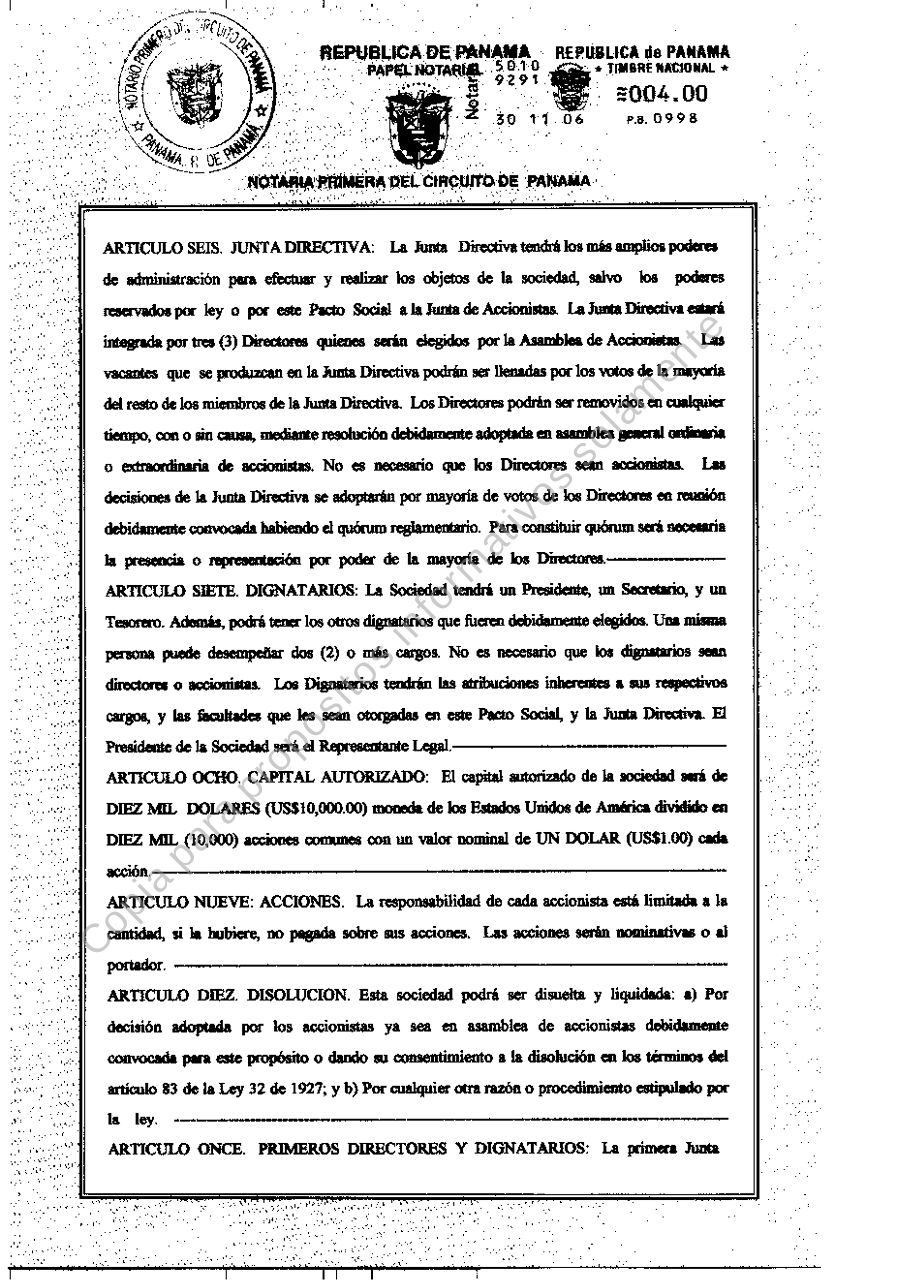
The deed of incorporation names the first directors, officers, resident agent and subscribers; each later deed records a change. The government's beneficial-owner guide of December 2025 states that the name, type, status, articles, address and the list of directors, officers and members are open to the public online, free of charge.18 Later shareholders of a sociedad anónima, beneficial owners and the accounting records of ordinary private companies are kept outside the register.
Directors
A sociedad anónima is managed by a junta directiva (board of directors) of at least three members, article 49 of Ley 32 de 1927; the article speaks of adults. The pacto social gives the number of directors and their names and addresses, article 2. Directors need not be shareholders unless the pacto social says otherwise, article 55.3 The qualification manual of the Registro Público requires three different directors and accepts legal persons as directors, with their registration details.22 The board elects the dignatarios (officers): a president, a secretary and a treasurer, article 65.3
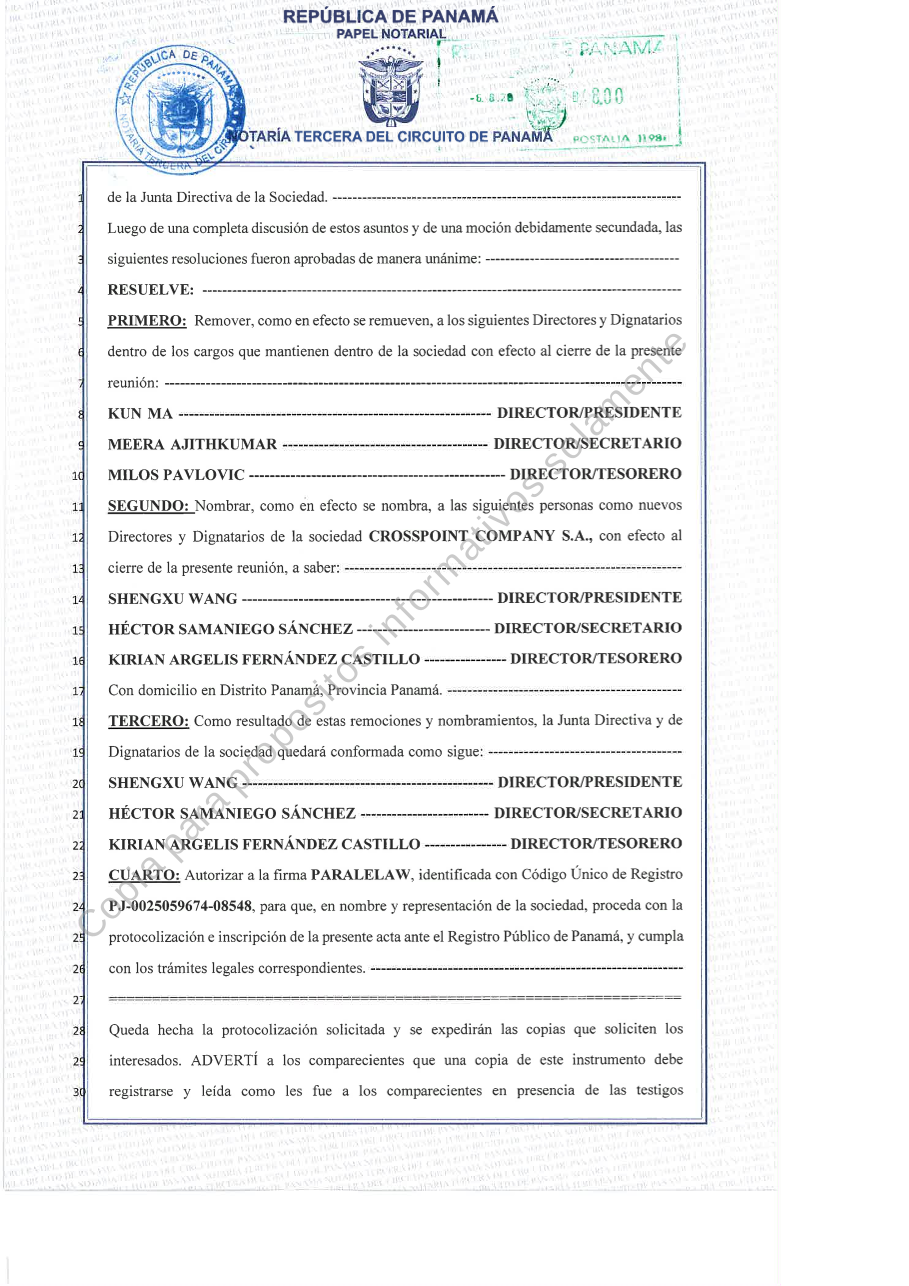
A change of directors is registered by public deed, after the standing of the directors who acted until the change, article 63 of Ley 32 de 1927.3 The law sets no time limit to register it; until it is presented to the register, the change does not affect third parties, article 1761 of the Código Civil.1
A limited liability company is managed by administrators, natural or legal persons, members or not, articles 5 and 38 of Ley 4 de 2009.4 A foundation is managed by a consejo de fundación (foundation council) of at least three members, or one legal person, article 17 of Ley 25 de 1995.6
Resident agent
The pacto social of every sociedad anónima names its agent in Panama, which Ley 32 de 1927 allows to be a legal person, article 2.3 For limited liability companies and foundations the agent must be a lawyer or a law firm, article 5 of Ley 4 de 2009 and article 5 of Ley 25 de 1995.46 Ley 129 de 2020 defines the resident agent of any legal person as a lawyer or a law firm, article 2.11 Since that law every resident agent must be registered with the Superintendencia de Sujetos no Financieros (Superintendency of Non-Financial Entities), and a company whose agent is not registered has its corporate rights suspended, articles 3 and 6.11 A company left without a resident agent for more than 90 days is also suspended, article 318-A of the Código Fiscal (Fiscal Code), paragraph 2.10
Beneficial owners
Ley 129 de 2020, of 17 March 2020, created the Sistema Privado y Único de Registro de Beneficiarios Finales (Private and Single System for the Registration of Beneficial Owners), run by the Superintendencia de Sujetos no Financieros, article 7. By law it is free, private and of limited access, article 8.11 It is not part of the Registro Público.
A beneficial owner is the natural person who ultimately, directly or indirectly, owns, controls or has significant influence, including whoever has final effective control of a legal person, article 4 of Ley 23 de 2015 (Law 23 of 2015) as amended by Ley 254 de 2021 (Law 254 of 2021).10 The government's guide of December 2025 says that Decreto Ejecutivo 35 de 2022 (Executive Decree 35 of 2022), which regulates Ley 23 de 2015 for non-financial obliged persons, requires three tests together: ownership of 25% or more of the legal person (the guide gives 10% or more for the financial sector); control by other means, such as a chain of companies or representatives; and, only when no person is found by those two tests, the natural person who holds the highest management position.18 The percentage is one test, not the whole definition. The regulation of 2015 had set the same percentages, article 8 of Decreto Ejecutivo 363 de 2015 (Executive Decree 363 of 2015).17
The resident agent enters the company's name, folio number, date of registration, address and activity, and each beneficial owner's name, identity document, date of birth, nationality, address and the date the person became an owner, article 10.11 The data are entered within 15 working days of incorporation or of a new agent's appointment, article 11. The company reports a change to its agent within 15 working days, and the agent updates the system within 5 working days, article 12. The data are kept at least five years after the company's dissolution is registered, article 21.11
Who can see it today
Access is limited to the company's resident agent and two officials of the Superintendencia, who pass information to the competent authorities, article 14.11 Any judicial, administrative or other action for access by anyone else is inadmissible by law, article 9, and unauthorised access is fined PAB 500,000, article 26.11 The public has no access. The system has been private since the law was made in 2020; Ley 254 de 2021, of 11 November 2021, rewrote the access article and kept that rule.11
A resident agent who does not register or update the data is fined PAB 1,000 to PAB 50,000 for each company, article 23, and the company's corporate rights are suspended, article 24.11
Financial statements
Ordinary private companies in Panama are not required to file annual accounts at the Registro Público, and their accounting records are not public. Separate rules apply to banks. Banks with a general or international licence give their audited financial statements to the Superintendencia de Bancos (Superintendency of Banks) within three months of the year end, and publish them in a national newspaper within 30 days after that, articles 87 and 88 of the Ley Bancaria (Banking Law, Decreto Ley 9 de 1998).23 A foreign corporation that registers to do business in Panama files a copy of its last balance sheet once, to register, article 90 of Ley 32 de 1927; these are not annual accounts.3
Every company must keep records. Every merchant keeps a journal and a ledger, and every commercial company also keeps a minutes book and a share or quota register, article 73 of the Código de Comercio (Commercial Code) as rewritten by Ley 52 de 2016.9
Since 1 January 2017 Ley 52 de 2016 adds rules for legal persons that do not carry out operations taking effect in Panama and for pure holding companies, article 1 as rewritten by Ley 254 de 2021. They keep accounting records and supporting documents for at least five years. By 30 April each year they give their resident agent the records, or a copy, for the previous calendar year, or the documents the regulation requires.924
That is the general rule. The exemptions and the documents to give depend on the company's circumstances under the current regulation, Decreto Ejecutivo 177 de 2024 (Executive Decree 177 of 2024), of 30 December 2024. It exempts taxpayers in Panama, companies listed on a recognised stock exchange, companies owned by an international body or a state, and owners or charterers of ships registered exclusively in the international service of the Panamanian merchant marine, article 3. Depending on its situation, a company gives its agent a sworn statement that it only holds assets, a financial statement or a summary of its financial position, or a statement that it has no activity, income or assets, articles 4 to 6.24
By 15 July each year the resident agent files a sworn return with the Dirección General de Ingresos listing the companies it serves and where their records are, article 3 of Ley 52 de 2016.9 The 2024 regulation had set 15 June. Decreto Ejecutivo 42 de 2025 (Executive Decree 42 of 2025), of 7 November 2025, replaced its article 7 and set 15 July.2425 The authority keeps the information it receives from the agent in strict confidence, article 4 of Ley 52 de 2016. A company that breaks these duties is fined PAB 5,000 to PAB 1,000,000 and can be suspended, article 7.9
Filings
Only titles in a public deed, a final court decision or order, or another authentic document expressly specified by law for the purpose can be registered, article 1756 of the Código Civil. Registration can be requested by the notary before whom the deed was made, by anyone with an interest in securing the right, or by a legal representative or attorney, article 1757.1
Scroll sideways to see all columns.
| Filing | What it reports | Time limit | Law |
|---|---|---|---|
| Pacto social (S.A.) | Incorporation: subscribers, capital, office, resident agent, directors | No effect on third parties until registered | Ley 32 de 1927 arts 2, 63 |
| Pacto social (S. de R.L.) | Incorporation: members, capital, administrators, resident agent | Personality from registration | Ley 4 de 2009 arts 5, 64 |
| Acta fundacional | Foundation: assets, council, resident agent, purposes | Personality from registration | Ley 25 de 1995 arts 5, 96 |
| Estatuto tipo | Sociedad de emprendimiento; later changes | Changes within 30 days | Ley 186 de 2020 arts 7, 107 |
| Amendment of the articles | Capital, name, objects, other clauses | — | Ley 32 de 1927 arts 7–123 |
| Change of directors and officers | New board or officers | No statutory limit | Ley 32 de 1927 art. 633 |
| Transfer of quotas | New members of an S. de R.L. | Must be registered | Ley 4 de 2009 arts 11, 264 |
| Change of resident agent | New agent; its statement on the accounting records | 90 days after the previous agent leaves | Ley 52 de 2016 art. 29; Código Fiscal art. 318-A10 |
| Bearer-share custody resolution | The company joins custody | 31 December 2015 | Ley 47 de 2013 art. 2513 |
| Merger agreement | Companies combine | Effective on registration | Ley 32 de 1927 arts 75, 763 |
| Dissolution | Shareholders' resolution, list of directors and officers | Published at least once in a newspaper | Ley 32 de 1927 arts 81, 823 |
| Foreign company | Protocolised articles; last balance sheet with a statement of the capital used or to be used in Panama; certificate that it is constituted and authorised under its home law | Before doing business | Ley 32 de 1927 art. 903 |
Three yearly duties are not filed at the register: the tasa única anual (single annual fee) paid to the Dirección General de Ingresos (see Company status), the delivery to the resident agent by 30 April of the records, or the documents the regulation requires, by the companies that Ley 52 de 2016 covers, and the agent's sworn return by 15 July.925
Documents and certificates
The Registro Público issues certificates (certificaciones) on the legal persons it registers. A company in arrears with its annual fee gets no certificates. An authority, or a third party who needs one to enforce its rights, still gets a certificate that shows the arrears, article 318-A of the Código Fiscal, paragraph 1.9 The same applies while a company is suspended because its beneficial-owner data were not registered or updated, article 24 of Ley 129 de 2020.11
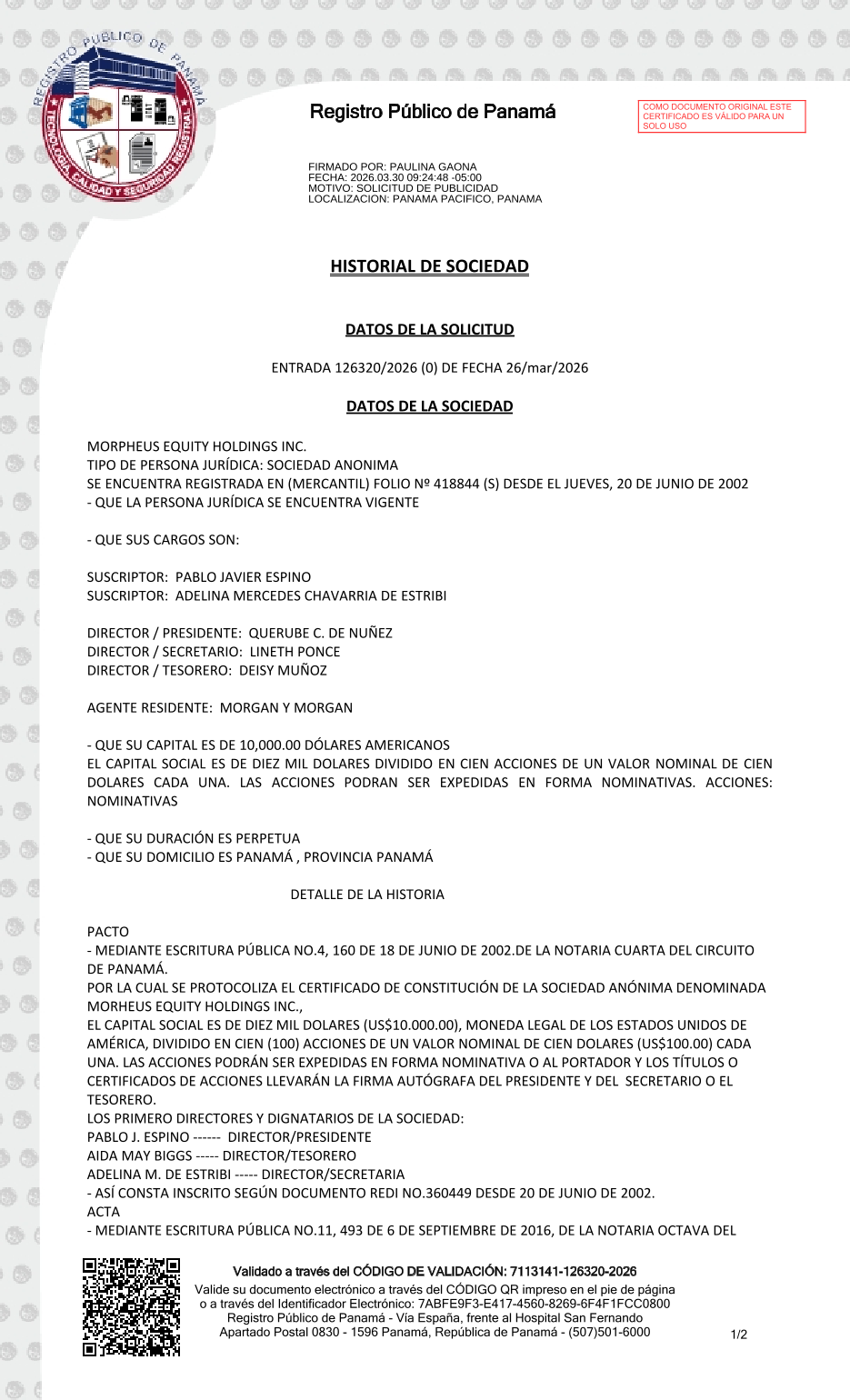
Notaries issue authenticated copies of protocol deeds to any person, with the marginal notes of the original, article 1752 of the Código Civil.1 A certified copy of the articles and of each amendment can be ordered that way.
Panama acceded to the Hague Apostille Convention on 30 October 1990, and the Convention has applied to Panama since 4 August 1991.20 Article 1 of the Convention treats administrative documents and notarial acts as public documents, so certificates of the Registro Público and notarial copies can be apostilled for use in the other member states.21 An apostille certifies the authenticity of the signature, the capacity in which the signer acted and, where appropriate, the identity of the seal or stamp, articles 3 and 5 of the Convention.21 Since 27 May 2025 the Ministerio de Relaciones Exteriores (Ministry of Foreign Affairs), one of Panama's competent authorities, can issue electronic apostilles on public documents that meet the requirements of Panamanian law, and they can be checked in its electronic register.27
Charges and mortgages
None of the four sections in article 1754 of the Código Civil is a register of company charges; since Ley 129 de 2013 movable-property mortgages are filed in the Registro Público's movable-property department or in the register of the asset (below). Mortgages over real estate are registered in its Registro de Hipotecas (Mortgage Register), article 1754 of the Código Civil.1 A pledge over quotas of a limited liability company may be registered or not, at the members' option, article 18 of Ley 4 de 2009.4
Movable assets, such as receivables, inventory and intellectual property rights, can be charged by a hipoteca de bien mueble (movable-property mortgage) under Ley 129 de 2013 (Law 129 of 2013), of 31 December 2013, article 2. The mortgage is constituted when it is filed, and it has effect against third parties from its filing, articles 31 and 32. It is filed in the Registro Público, or in the register that records the ownership of the asset, such as the vehicle register or the industrial property register, articles 3 and 34.26 The Registro Público qualifies and registers these mortgages in its Departamento de Bienes Muebles (movable property).22 A search of a company's folio may not show all charges over the company's assets.
Company status
Annual fee and arrears
Every sociedad anónima, limited liability company and other legal person pays a tasa única anual of PAB 300 to keep its registration in force; a private-interest foundation pays PAB 350 at registration and PAB 400 in later years, article 318-A of the Código Fiscal as rewritten by Ley 52 de 2016. Non-profit organisations, cooperatives and sociedades civiles (civil partnerships) do not pay it. The fee is due by 15 July for companies registered from January to June and by 15 January for the others; late payment adds PAB 50 a year.9
A company that has not paid is in arrears (morosa). The Registro Público registers no corporate act for it, except resignations of directors and of the resident agent, article 318-A, paragraph 1.9
Suspension
The Registro Público suspends the corporate rights of a company that has had no resident agent for more than 90 days, has not paid the fee for three consecutive years (on the order of the Dirección General de Ingresos), or breaks a law whose sanction is suspension, article 318-A, paragraph 2, as rewritten by Ley 254 de 2021.10 Since 2019 the status "suspendido" is shown on the company's folio, Decreto Ejecutivo 905 de 2019.14 A suspended company cannot start proceedings, do business, dispose of its assets or take binding corporate action. It can apply for reactivation, defend itself and continue earlier proceedings, paragraph 3.9
Reactivation and dissolution today
Since Ley 254 de 2021 came into force in November 2021, a suspended company has one year from the registration of its suspension to be reactivated, article 318-A, paragraph 4. Any director, shareholder, partner or interested third party may apply through the resident agent, cure the cause and pay the reactivation fine of PAB 1,000 that the law sets, paragraph 5. The Dirección General de Ingresos states that private-interest foundations do not pay its rehabilitation fine but must be up to date with the annual fee.29 When the year passes without reactivation, the Registro Público notifies the authority that ordered the suspension; that authority orders the dissolution and the Registro Público registers it, paragraph 6. A company that keeps failing its duties three months after the deadline can be put into administrative forced liquidation, paragraph 2.10
From 1 January 2017 to November 2021 the period was two years, after which the register cancelled the company.9 From 2005 to the end of 2016 a company that did not pay for ten consecutive years was removed from the register and treated as dissolved, article 9 of Ley 6 de 2005 (Law 6 of 2005).15 Ley 49 de 2009 (Law 49 of 2009) added three years to rehabilitate it, article 1.16
The dissolutions of 2026
In a notice of 23 February 2026 the Ministerio de Economía y Finanzas (Ministry of Economy and Finance) announced the dissolution of suspended legal persons from 27 February 2026, in two stages: first the 290,534 legal persons that carry a dissolution note for unpaid fees under resolutions of the Dirección General de Ingresos of 2016; then the legal persons with suspended status under article 318-A as amended by Ley 52 de 2016 and Ley 254 de 2021.19
The Registro Público publishes the results. On 27 February 2026 it dissolved 180,346 of a first block of 180,883 legal persons. On 31 March 2026 it dissolved 25,766 of a second block of 25,777. The next block, 154,029 legal persons suspended from 2017 to 2021 under Ley 52 de 2016, had no date on 12 October 2026: the Registro Público said it was being rescheduled and would announce the new date.28
Voluntary dissolution
A sociedad anónima is dissolved by a resolution of the majority of the voting shares on the board's proposal, or by the written consent of all voting shareholders; the resolution is registered and published once in a newspaper, articles 80 to 84 of Ley 32 de 1927. It then continues for three years only to wind up, with its directors as trustees, articles 85 and 86.3 The dissolution deed is registered only with the resident agent's statement that it holds the accounting records of the last five years, which it keeps for five more years, article 2 of Ley 52 de 2016.9
A limited liability company is dissolved for the causes in article 44 of Ley 4 de 2009, among them fewer than two members for more than 60 working days.4 A foundation is dissolved at the end of its term, when its purpose is achieved or impossible, on insolvency, on the loss of all its assets, on revocation or for a cause in its charter, article 25 of Ley 25 de 1995.6
Legislation
Scroll sideways to see all columns.
| Law | What it governs |
|---|---|
| Código Civil (1916), arts 1753 and following1 | The Registro Público and registration |
| Ley 32 de 19273 | Sociedades anónimas, foreign corporations |
| Ley 25 de 19956 | Private-interest foundations |
| Ley 3 de 19992 | The Registro Público as an autonomous entity |
| Ley 4 de 20094 | Limited liability companies |
| Ley 47 de 201312 | Custody of bearer shares |
| Ley 129 de 201326 | Mortgages over movable property |
| Ley 52 de 20169 | Accounting records; annual fee and suspension (Código Fiscal art. 318-A) |
| Ley 129 de 202011 | Private register of beneficial owners |
| Ley 186 de 20207 | Sociedades de emprendimiento |
| Ley 254 de 202110 | Amends the anti-money-laundering, records and beneficial-owner laws and art. 318-A |
| Ley 451 de 20248 | Amends the sociedades de emprendimiento law |
Timeline
- 1 July 1917: the Código Civil and its register rules come into force.1
- 1 April 1927: Ley 32 de 1927 on sociedades anónimas.3
- 12 June 1995: Ley 25 de 1995 creates the private-interest foundation.6
- 6 January 1999: Ley 3 de 1999 makes the Registro Público autonomous.2
- 2 February 2005: Ley 6 de 2005 rewrites the annual fee (Código Fiscal art. 318-A): dissolution after ten unpaid years.15
- 9 January 2009: Ley 4 de 2009 replaces Ley 24 de 1966.4
- 17 September 2009: Ley 49 de 2009 extends the fee to all legal persons.16
- 31 December 2013: Ley 129 de 2013 on mortgages over movable property.26
- 4 May 2015: custody of bearer shares begins (Ley 47 de 2013).13
- 1 January 2017: Ley 52 de 2016: accounting records and suspension.9
- 17 March 2020: Ley 129 de 2020: private register of beneficial owners.11
- 2 December 2020: Ley 186 de 2020: sociedad de emprendimiento.7
- 11 November 2021: Ley 254 de 2021: one year to reactivate; dissolution ordered by the authority.10
- 31 October 2024: Ley 451 de 2024 amends the sociedades de emprendimiento law.8
- 30 December 2024: Decreto Ejecutivo 177 de 2024 regulates the accounting-records duties of Ley 52 de 2016; Decreto Ejecutivo 42 de 2025 amends it on 7 November 2025.2425
- 27 February and 31 March 2026: the Registro Público dissolves 206,112 legal persons marked for dissolution in 2016 for unpaid fees.1928
Questions
Who keeps the company register in Panama?
The Registro Público de Panamá, an autonomous state entity under Ley 3 de 1999. Companies are registered in its mercantile section under articles 1753 to 1777-A of the Código Civil.
Is the Panama company register public?
Yes. Under article 1755 of the Código Civil the Registro Público de Panamá is public and anyone can consult it. It shows a company's name, type, status, articles, directors, officers and resident agent.
Can I find the shareholders of a Panama company?
For a sociedad anónima the Registro Público de Panamá shows only the subscribers named at incorporation. Later shareholders are in the company's own share register, article 36 of Ley 32 de 1927. The members of a limited liability company are registered, Ley 4 de 2009.
Is there a public register of beneficial owners in Panama?
No. Ley 129 de 2020 created a private system run by the Superintendencia de Sujetos no Financieros, separate from the Registro Público de Panamá. Only the company's resident agent and two officials can access it, for the competent authorities, article 14.
Do Panama companies file annual accounts?
Ordinary private companies are not required to file annual accounts at the Registro Público de Panamá. They keep accounting records, and companies that do not operate in Panama, and pure holding companies, give them, or the documents the regulation requires, to their resident agent each year under Ley 52 de 2016, with exemptions. Banks publish audited statements under articles 87 and 88 of the Ley Bancaria. A foreign corporation registering to do business in Panama files its last balance sheet once, to register, article 90 of Ley 32 de 1927.
Are bearer shares still allowed in Panama?
Only in custody with an authorised custodian, under Ley 47 de 2013. A company that did not join the custody regime by 31 December 2015 is treated as prohibiting them, and since 2017 an undeposited bearer share has no rights.
What does "suspended" mean for a Panama company?
The Registro Público de Panamá suspends the corporate rights of a company without a resident agent for over 90 days, three years behind with its annual fee, or in breach of a law that carries that sanction, article 318-A of the Código Fiscal. It cannot do business or dispose of its assets.
Can a suspended Panama company be reactivated?
Yes, within one year of the suspension's registration in the Registro Público de Panamá, through its resident agent, by curing the cause and paying the PAB 1,000 fine set by article 318-A of the Código Fiscal as amended in 2021. The Dirección General de Ingresos states that private-interest foundations do not pay its rehabilitation fine. After the year the authority orders the dissolution.
Can Panama company documents be apostilled?
Yes. Panama has applied the Hague Apostille Convention since 4 August 1991, so certificates of the Registro Público de Panamá can be apostilled. The apostille certifies the signature, the capacity of the signer and the seal or stamp. Since 27 May 2025 the Ministry of Foreign Affairs can issue electronic apostilles.
Sources
- Código Civil de la República de Panamá (Ley 2 de 22 de agosto de 1916), articles 1752–1761, 1777-A, 1795. Read on 16 November 2026.
- Ley 3 de 6 de enero de 1999, Registro Público de Panamá, articles 1–4, 20. Read on 16 November 2026.
- Ley 32 de 26 de febrero de 1927, sobre sociedades anónimas, articles 1–96. Read on 16 November 2026.
- Ley 4 de 9 de enero de 2009, sociedades de responsabilidad limitada, articles 1–53. Read on 16 November 2026.
- Ley 24 de 1 de febrero de 1966, empresas de responsabilidad limitada, articles 1–7, 14, 63. Read on 16 November 2026.
- Ley 25 de 12 de junio de 1995, fundaciones de interés privado, articles 1–37. Read on 16 November 2026.
- Ley 186 de 2 de diciembre de 2020, sociedades de emprendimiento (Gaceta Oficial 29167-B), articles 1–50. Read on 16 November 2026.
- Ley 451 de 31 de octubre de 2024 (Gaceta Oficial 30152-A), articles 1–9. Read on 16 November 2026.
- Ley 52 de 27 de octubre de 2016, registros contables, consolidated to 2 December 2021, articles 1–14, including article 318-A of the Código Fiscal (article 9). Read on 16 November 2026.
- Ley 254 de 11 de noviembre de 2021 (Gaceta Oficial 29413-A), articles 1, 44, 46–48. Read on 16 November 2026.
- Ley 129 de 17 de marzo de 2020, Sistema Privado y Único de Registro de Beneficiarios Finales, consolidated to 18 November 2021, articles 1–30. Read on 16 November 2026.
- Ley 47 de 6 de agosto de 2013, custodia de acciones al portador, articles 1–28. Read on 16 November 2026.
- Ley 18 de 2015 (Gaceta Oficial 27766-B, 23 April 2015), articles 1–7. Read on 16 November 2026.
- Decreto Ejecutivo 905 de 2019 (Gaceta Oficial 28866-A, 23 September 2019), articles 1–6. Read on 16 November 2026.
- Ley 6 de 2 de febrero de 2005, article 9 (article 318-A of the Código Fiscal). Read on 16 November 2026.
- Ley 49 de 17 de septiembre de 2009, article 1 (article 318-A of the Código Fiscal). Read on 16 November 2026.
- Decreto Ejecutivo 363 de 13 de agosto de 2015, regulation of Ley 23 de 2015, article 8. Read on 16 November 2026.
- Guía de Beneficiarios Finales para Panamá, prepared with information from the Panamanian authorities, published 17 December 2025, section 1. Read on 16 November 2026.
- Ministerio de Economía y Finanzas, notice of 23 February 2026 on the dissolution of suspended legal persons. Read on 16 November 2026.
- Hague Conference on Private International Law, status table of the Apostille Convention, entry for Panama. Read on 16 November 2026.
- Convention of 5 October 1961 Abolishing the Requirement of Legalisation for Foreign Public Documents, articles 1, 3 and 5. Read on 16 November 2026.
- Registro Público de Panamá, Manual de Calificación del Registro Público de Panamá, first edition 2019, part B (mercantile), section 1.19, and part C (Bienes Muebles), II (Sección de Automotor), 1. Read on 16 November 2026.
- Ley Bancaria, single text of Decreto Ley 9 de 26 de febrero de 1998 adopted by Decreto Ejecutivo 52 de 30 de abril de 2008 (Superintendencia de Bancos edition), articles 87 and 88. Read on 16 November 2026.
- Decreto Ejecutivo 177 de 30 de diciembre de 2024, regulation of Ley 52 de 2016, articles 1–9. Read on 16 November 2026.
- Decreto Ejecutivo 42 de 7 de noviembre de 2025, which amends article 7 of Decreto Ejecutivo 177 de 2024, articles 1–3. Read on 16 November 2026.
- Ley 129 de 31 de diciembre de 2013, movable-property mortgages (Gaceta Oficial 27449-C, 8 January 2014), English translation by the Superintendencia de Bancos, articles 2, 3, 31–34. Read on 16 November 2026.
- Hague Conference on Private International Law, e-APP notification No. 10 of 2025 (Panama), 21 November 2025. Read on 16 November 2026.
- Registro Público de Panamá, Descargar Folios Suspendidos y Disueltos (lists and results of the dissolutions of 2026), page as published on 12 October 2026. Read on 16 November 2026.
- Dirección General de Ingresos, questions and answers on the tasa única, questions 5–7. Read on 16 November 2026.
New in the register
This guide was reviewed on 16 November 2026 against the laws in its sources list. It is general information and not legal advice. Dato Capital is a private company; it is not the Registro Público de Panamá and does not act for it.